Model a treatment train#
This tutorial models a conventional surface-water treatment train: coagulation, flocculation, sedimentation, filtration, and disinfection (CDC overview). You will connect the stages, mark the system boundary, explore the result, save it, and load it again.
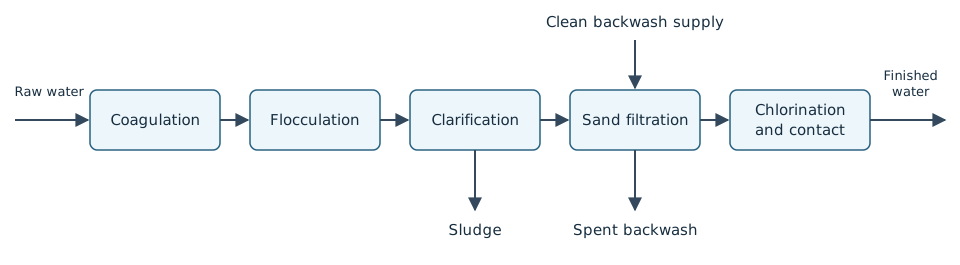
The model records equipment, connectivity, and treatment intent. It does not calculate removal, dose, or contact time.
1. Import the stages#
plumb.watr.drinking_water provides one class per stage. Each subclasses
a WaTr equipment class and fixes its process, objective, and named ports.
Stage |
Class |
WaTr parent |
|---|---|---|
Coagulation |
|
|
Flocculation |
|
|
Clarification |
|
|
Filtration |
|
|
Disinfection |
|
|
from plumb import Model, connect
from plumb.watr import SedimentationTank
from plumb.watr.drinking_water import (
    ChlorinationStage,
    ClarificationStage,
    CoagulationStage,
    FlocculationStage,
    RapidSandFiltrationStage,
)
2. Connect the stages#
Connect named ports along the production path. The clarifier’s sludge
outlet and the filter’s backwash ports are separate points, so waste cannot
end up feeding the next stage.
with Model("urn:example/treatment#") as model:
    with model.system("treatment-system") as system:
        coagulation = CoagulationStage("coagulation")
        flocculation = FlocculationStage("flocculation")
        clarifier = ClarificationStage("clarifier")
        sand_filter = RapidSandFiltrationStage("sand-filter")
        disinfection = ChlorinationStage("chlorination-contact")

        connect(coagulation.outlet, flocculation.inlet, name="coagulated-water")
        connect(flocculation.outlet, clarifier.inlet, name="flocculated-water")
        connect(
            clarifier.clarified_water, sand_filter.inlet, name="clarified-water"
        )
        connect(
            sand_filter.filtered_water, disinfection.inlet, name="filtered-water"
        )

        system.boundary(
            coagulation.inlet,
            disinfection.outlet,
            clarifier.sludge,
            sand_filter.backwash_supply,
            sand_filter.backwash_waste,
        )
model.system() groups the stages. boundary() marks the points where flow
crosses into or out of the system: raw water in, finished water out, sludge
out, and backwash water in and out.
3. Explore the result#
compile() resolves the connections, validates the model, and returns a
snapshot:
resolved = model.compile()
Look up the clarifier and list its process and objective:
resolved_clarifier = resolved["clarifier"]

for process in resolved_clarifier.has_process:
    print("process:", process.meta.label)

for objective in resolved_clarifier.has_treatment_objective:
    print("objective:", objective.meta.label)
process: Settling
objective: Clarification
Look up a pipe by its name and see which points it joins:
pipe = resolved["clarified-water"]
print(pipe.type, pipe.medium)
for point in pipe.connects_at:
    print(point.owner.name, point.label)
Pipe <enum Fluid-Water>
clarifier clarified_water
sand-filter inlet
List the points where flow crosses the system boundary:
plant = resolved["treatment-system"]
for point in plant.has_boundary_connection_point:
    print(point.owner.name, point.label, point.type, point.medium)
chlorination-contact outlet OutletConnectionPoint <enum Fluid-Water>
clarifier sludge OutletConnectionPoint <enum Fluid-Sludge>
coagulation inlet InletConnectionPoint <enum Fluid-Water>
sand-filter backwash_supply InletConnectionPoint <enum Fluid-Water>
sand-filter backwash_waste OutletConnectionPoint <enum Fluid-Water>
Sludge is its own medium. Both filter outlets carry water and are told apart by name.
Follow the flow instead of reading pipes one at a time. find_all_next()
steps over pipes and points and returns the equipment downstream, nearest
first:
resolved["coagulation"].find_all_next()
[<FlocculationStage 'flocculation'>,
 <ClarificationStage 'clarifier'>,
 <RapidSandFiltrationStage 'sand-filter'>,
 <ChlorinationStage 'chlorination-contact'>]
Class arguments match subclasses, so asking for a SedimentationTank
upstream of disinfection finds the clarifier:
resolved["chlorination-contact"].find_previous(SedimentationTank)
<ClarificationStage 'clarifier'>
4. Save and load#
model.save("treatment.ttl")
The file imports the drinking-water ontology, so from_graph() selects the
right package. Query by the WaTr parent class:
loaded = Model.from_graph("treatment.ttl")
loaded.find_all(SedimentationTank)
[<ClarificationStage 'clarifier'>]
The clarifier was saved as a ClarificationStage, which is a kind of
SedimentationTank. A loaded model has its pipes and points already, so it
can be walked without resolving:
loaded["clarifier"].find_next()
<RapidSandFiltrationStage 'sand-filter'>
5. Draw it#
from plumb import flowsheet

flowsheet(loaded, title="Conventional treatment train")
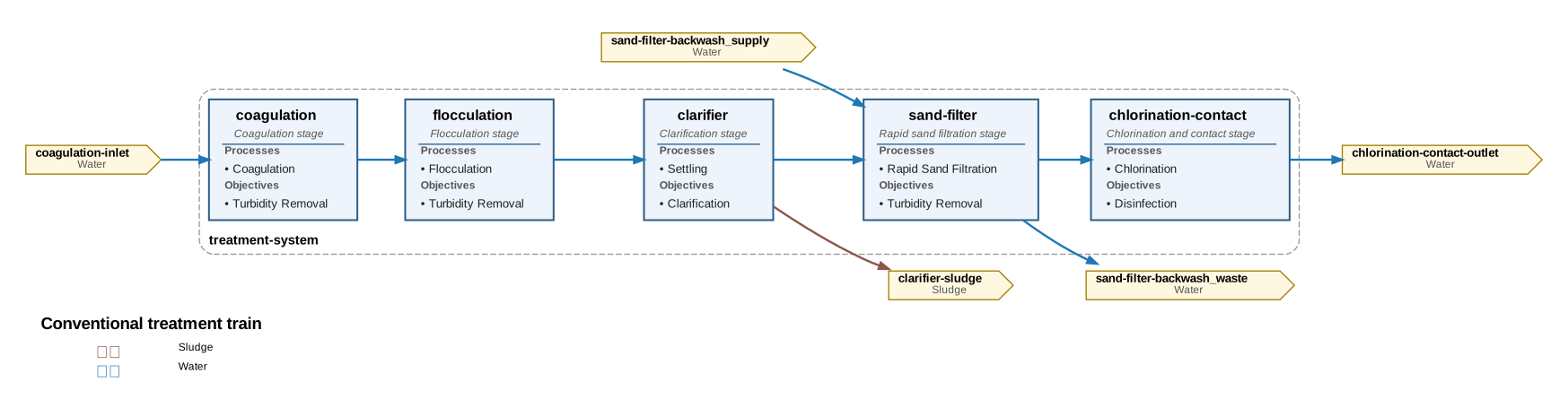
Unconnected boundary points are drawn as feed and product terminals.
Next#
Instrument a plant adds pumps, residuals
handling, an influent property set, sensors, and actuators to this train. The
script version is examples/watr/treatment/watr_quickstart.py.