Plumb#
Write water and wastewater treatment plant models in Python and get RDF that conforms to WaTr and ASHRAE 223P.
A semantic model of a plant is useful to analytics, controls, and digital twins, but writing one by hand is slow: every pipe needs connection points on both ends, matching media, inverse links, and the right classes, and nothing checks the result until a SHACL validator runs. Plumb lets you state what the plant is. It fills in the rest and checks it as you go.
from plumb import Model, connect, flowsheet
from plumb.qudt import quantity_kinds, units
from plumb.watr import Pump
from plumb.watr.drinking_water import (
    ClarificationStage,
    CoagulationStage,
    RapidSandFiltrationStage,
)

with Model("urn:example:plant#") as model:
    intake = Pump("intake-pump")
    coagulation = CoagulationStage("coagulation")
    clarifier = ClarificationStage("clarifier")
    sand_filter = RapidSandFiltrationStage("sand-filter")

raw_water = connect(intake, coagulation.inlet, name="raw-water")
connect(coagulation.outlet, clarifier.inlet, name="coagulated-water")
settled = connect(clarifier.clarified_water, sand_filter.inlet, name="settled-water")

raw_water.quantity("raw-turbidity", 18.0, unit=units.NTU, kind=quantity_kinds.Turbidity)
settled.sensor("settled-turbidity", kind=quantity_kinds.Turbidity, unit=units.NTU)

model.save("plant.ttl")
flowsheet(model)
Features#
Typed classes generated from the ontologies. Every WaTr and 223P class, process, medium, and role is a Python class or value, with editor completion, type checking, and the ontology’s definitions in its docstrings. Required properties are required arguments.
Connections inferred from the shapes. connect(a, b) is enough. A solver
reads the SHACL shapes to choose connection points, media, and pipe classes,
and stops to ask when the model is ambiguous rather than guess.
Validation in Python terms. validate() runs the ontologies’ own SHACL
shapes and rules, and reports each violation against the Python object that
caused it.
Quantities, sensors, and actuators. Values carry QUDT units and quantity
kinds, checked for dimensional consistency. .sensor() and .actuator()
add an instrument and its property in one call.
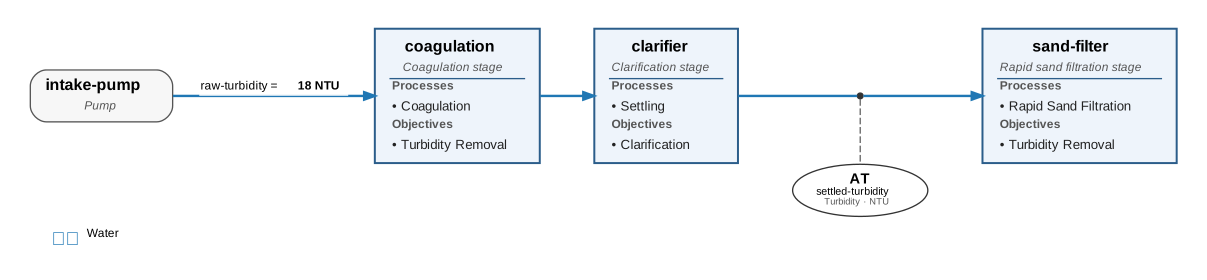
Flow sheets. flowsheet() draws any model, authored or loaded, with
processes, streams, and instruments.
Load, query, and edit. Model.from_graph() reads saved RDF back as the
same typed objects, chosen from the file’s owl:imports. find_all()
selects by class, medium, or role, and find_all_next() follows the flow
downstream, optionally through pipes of one medium only.
Domain packages. Reusable equipment layouts and property sets are written
in SHACL and compiled into Python packages, such as
plumb.watr.drinking_water above.
Install#
Plumb needs Python 3.12 or newer. From a checkout of the repository, install it and its dependencies with uv:
uv sync
To use it from another project, install the package from the repository:
pip install git+https://github.com/gtfierro/plumb
flowsheet() renders with Graphviz; install
it so dot is on your PATH. Everything else, including the bundled WaTr,
S223, and QUDT packages, installs with Plumb.
Start here#
An S223 air path builds a 223P building system with the same API.
The how-to guides each cover one task.