Instrument a plant#
This tutorial extends the treatment train into a plant with pumps, a clearwell, sludge thickening, and filter backwash. You will describe the raw water, add sensors and actuators, and draw the result.
1. Describe the influent#
A property schema is a group of quantities. Each field has a QUDT quantity kind, a unit, and the medium it describes.
from plumb import Model, PropertySchema, connect, flowsheet, quantity_field
from plumb.qudt import QuantityAmount as Q, quantity_kinds, units
from plumb.watr import GravityThickener, LevelSensor, Pump, Tank, enums
from plumb.watr.drinking_water import (
    ChlorinationStage,
    ClarificationStage,
    CoagulationStage,
    FlocculationStage,
    RapidSandFiltrationStage,
)

values = enums.values


class InfluentQuality(PropertySchema):
    """Raw surface-water quality at the plant intake."""

    flow_rate: float | Q = quantity_field(
        kind=quantity_kinds.VolumeFlowRate,
        unit=units.M3_PER_DAY,
        label="Raw-water flow",
        of_medium=values.Water_Freshwater,
        aspects=(values.Aspect_Nominal,),
        minimum=0,
    )
    turbidity: float | Q = quantity_field(
        kind=quantity_kinds.Turbidity,
        unit=units.NTU,
        label="Raw-water turbidity",
        of_medium=values.Water_Freshwater,
        aspects=(values.Aspect_Nominal,),
        minimum=0,
    )
    organic_carbon: float | Q = quantity_field(
        kind=quantity_kinds.MassConcentration,
        unit=units.MilliGM_PER_L,
        label="Total organic carbon",
        of_medium=values.Water_Freshwater,
        of_substance=values.Constituent_OrganicCarbon,
        aspects=(values.Aspect_Nominal,),
        minimum=0,
    )
    temperature: float | Q = quantity_field(
        kind=quantity_kinds.Temperature,
        unit=units.DEG_C,
        label="Raw-water temperature",
        of_medium=values.Water_Freshwater,
        aspects=(values.Aspect_Nominal,),
        default=12.0,
    )


raw = InfluentQuality(flow_rate=40_000, turbidity=Q(18.0, units.NTU), organic_carbon=3.5)
raw
InfluentQuality(flow_rate=40000, turbidity=QuantityAmount(value=18.0, unit=<term NTU>), organic_carbon=3.5, temperature=12.0)
Bare numbers take the field’s unit. Omitted fields take their default. Units and bounds are checked on creation:
try:
    InfluentQuality(flow_rate=40_000, turbidity=Q(18.0, units.KiloGM), organic_carbon=3.5)
except ValueError as error:
    print(error)
turbidity: incompatible unit http://qudt.org/vocab/unit/KiloGM
2. Create the equipment#
The stages come from drinking_water. Pumps, tanks, and the thickener are
plain WaTr classes.
model = Model("urn:example:surface-water#")

with model:
    with model.system("plant"):
        intake = Pump("raw-water-pump")
        coagulation = CoagulationStage("coagulation")
        flocculation = FlocculationStage("flocculation")
        clarifier = ClarificationStage("clarifier")
        sand_filter = RapidSandFiltrationStage("sand-filter")
        chlorination = ChlorinationStage("chlorine-contact")
        clearwell = Tank("clearwell", has_role=[values.Role_Storage])
        high_service = Pump("high-service-pump")

        sludge_pump = Pump("sludge-pump")
        thickener = GravityThickener("thickener")
        backwash_pump = Pump("backwash-pump")
        backwash_tank = Tank("backwash-recovery", has_role=[values.Role_Backwash])
The thickener’s process and objective come from its class:
list(thickener.has_process), list(thickener.has_treatment_objective)
([plumb.watr.Process_Settling], [plumb.watr.TreatmentObjective_Thickening])
3. Connect the main path#
Named points select stage ports. For a whole pump or tank, the solver picks the point.
raw_water = connect(intake, coagulation.inlet, name="raw-water")
connect(coagulation.outlet, flocculation.inlet, name="coagulated-water")
connect(flocculation.outlet, clarifier.inlet, name="flocculated-water")
connect(clarifier.clarified_water, sand_filter.inlet, name="clarified-water")
connect(sand_filter.filtered_water, chlorination.inlet, name="filtered-water")
connect(chlorination.outlet, clearwell, name="disinfected-water")
finished = connect(clearwell, high_service, name="finished-water")
print(model.check().status)
complete
4. Add residuals and backwash#
The sludge line needs a medium. A WaTr pump accepts water or sludge, so nothing else says which one flows.
connect(clarifier.sludge, sludge_pump, name="sludge-draw", medium=values.Fluid_Sludge)
connect(sludge_pump, thickener, name="sludge-to-thickener", medium=values.Fluid_Sludge)
connect(clearwell, backwash_pump, name="backwash-draw")
connect(backwash_pump, sand_filter.backwash_supply, name="backwash-supply")
connect(sand_filter.backwash_waste, backwash_tank, name="spent-backwash")
print(model.check().status)
complete
Mark where the plant meets the outside. These ports connect to nothing in the model:
model["plant"].boundary(
    intake.port("raw-water-suction", direction="in"),
    high_service.port("distribution", direction="out"),
    thickener.port("thickened-sludge", direction="out", medium=values.Fluid_Sludge),
    thickener.port("thickener-supernatant", direction="out", medium=values.Fluid_Water),
)
<System 'plant'>
5. Characterize the influent#
Attach the property set to the raw-water connection:
influent = raw_water.apply_properties(raw)
dict(influent)
{'flow_rate': <QuantifiableProperty 'raw-water-flow-rate'>,
 'turbidity': <QuantifiableProperty 'raw-water-turbidity'>,
 'organic_carbon': <QuantifiableProperty 'raw-water-organic-carbon'>,
 'temperature': <QuantifiableProperty 'raw-water-temperature'>}
turbidity = influent["turbidity"]
turbidity.has_value, turbidity.has_unit, turbidity.of_medium
(18.0, <term NTU>, <enum Water-Freshwater>)
6. Add instruments#
Call .sensor() on what is measured. Each observed property takes the
medium of the pipe or point it is on.
raw_water.sensor(
    "raw-water-flow", kind=quantity_kinds.VolumeFlowRate, unit=units.M3_PER_DAY
)
sand_filter.filtered_water.sensor(
    "filter-effluent-turbidity", kind=quantity_kinds.Turbidity, unit=units.NTU
)
finished.sensor(
    "chlorine-residual",
    kind=quantity_kinds.MassConcentration,
    unit=units.MilliGM_PER_L,
    of_substance=values.Constituent_ChlorineResidual,
)
clearwell.sensor(
    "clearwell-level", kind=quantity_kinds.Length, unit=units.M, sensor_class=LevelSensor
)
<LevelSensor 'clearwell-level'>
Give the high-service pump a speed command and an on/off command:
high_service.actuator("high-service-speed", kind=quantity_kinds.Frequency, unit=units.HZ)
high_service.actuator(
    "high-service-start", kind=values.Binary_OnOff, value=values.OnOff_Off
)
list(high_service.actuated_by_property)
[<QuantifiableActuatableProperty 'high-service-speed-command'>,
 <EnumeratedActuatableProperty 'high-service-start-command'>]
7. Resolve, validate, and draw#
resolved = model.compile()
resolved.explain(finished)
finished-water: clearwell-out -> high-service-pump-in
  medium: Fluid-Water (affinity preference)
  - selected OutletConnectionPoint clearwell-out
  - selected InletConnectionPoint high-service-pump-in
  - the solver minimized medium changes among otherwise valid choices
The clearwell feeds two pumps. explain() shows which outlet each
connection uses.
The chlorine analyzer was attached to the finished handle. In the snapshot,
its location is the concrete pipe:
analyzer = resolved["chlorine-residual"]
analyzer.has_observation_location
<Pipe 'finished-water'>
flowsheet(resolved, title="Surface-water treatment plant")
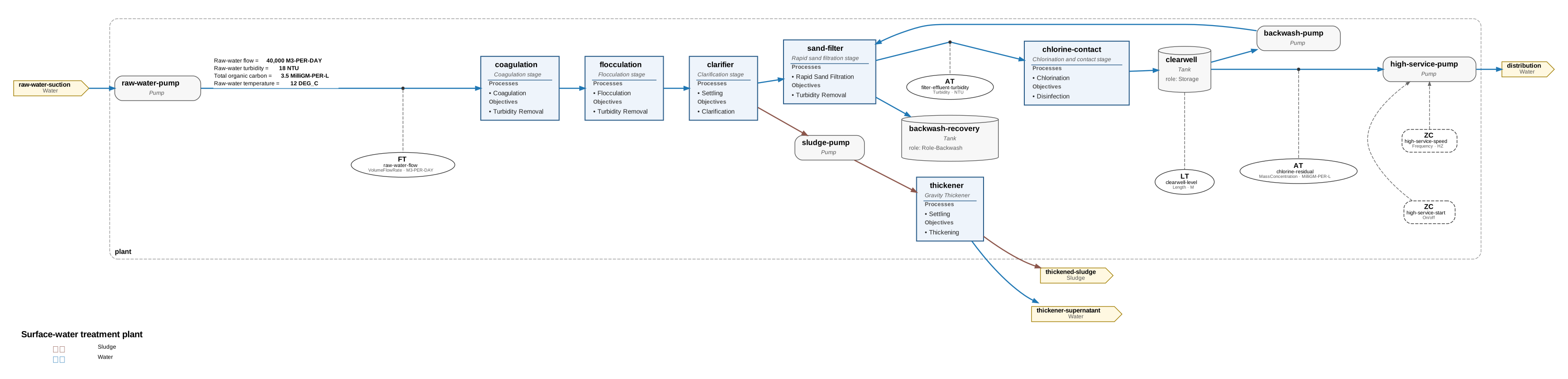
Save it:
model.save("plant.ttl")